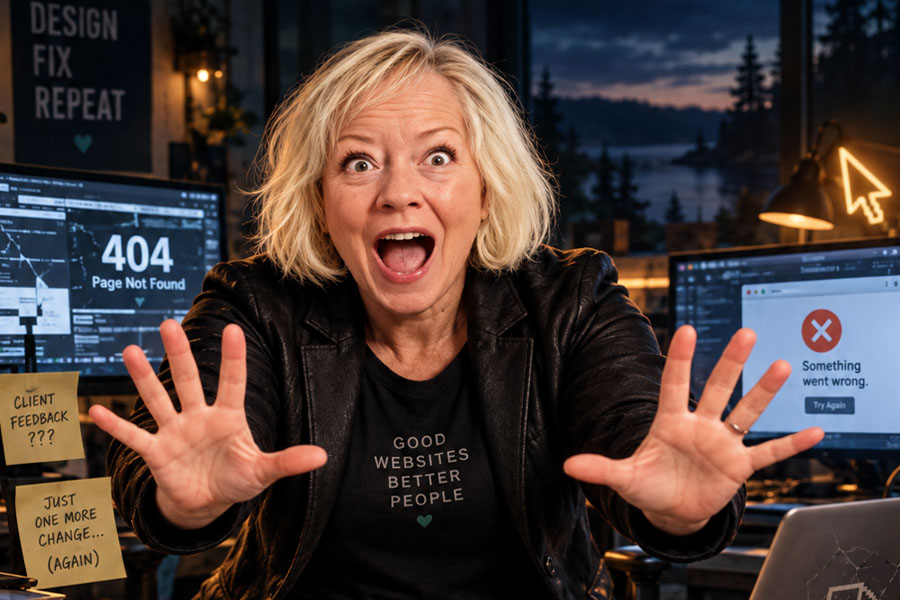
I have been building websites for more than 25 years now. Every once in a while I’ll say that out loud to someone and think, “Good grief, Charlie Brown…”
I have some weird thoughts about all these years of websites, search engines… and things web designers thought were a good idea.
Because “Internet years” are not the same as regular years. They’re more like dog years.
And I’ve seen things, good and bad.
I remember websites before smartphones.
I remember when we designed websites for computer monitors with dial-up modems.
The bad things I remember are those animated GIFs and visitor counters.
The worst had to be the “Under Construction” icons with a tiny cartoon construction worker digging a hole. Some designers launched a website before it was finished so I guess they needed to let us know…?
Designing Before Google Knew Everything
Younger users will find this hard to believe, but there was a time when Google was not around to answer every question we had.
Google didn’t launch until 1998.
Before Googling was a thing, people used search engines like AltaVista, Lycos, and Excite.
Some of us used AOL to find stuff.
And Yahoo was a really big deal.
In the early days of the Internet, we searched differently, and websites were different.
In the early days, if a business had a website, they seemed cutting-edge to those that didn’t.
“You have a WEBSITE? That’s very impressive!”
Oh, how things have changed.
Today, if I can’t find a business online in about 10 seconds, I wonder if it actually exists.
Websites Used to Be… Interesting
Early web design had a certain enthusiasm.
In my early web designer days, I’d discover all these cool codes. I’m afraid my response was:
“I want to use ALL of it!”
Blinking text? Absolutely.
Animated graphics? Yes.
Scrolling words? Obviously.
Background music that automatically started playing? I must have it.
And that fabulous visitor counter. (I still have clients asking for it today.)
Flash in the Pan
How can I forget Flash websites? What a nightmare…
Everyone wanted an animated introduction that was a full-screen Flash file.
I hated visiting a business website where I had to sit through a 30-second animation first.
Then you could enter the gates and discover what the company actually did.
I always looked for the tiny link that said Skip Intro. I know I’m not the only one who clicked that link quickly.
Read “What Happened to Adobe Flash?”
Then Websites Started Growing Up
Eventually, we began figuring out that visitors didn’t want an online special-effects demonstration.
They wanted information.
- What do you do?
- Where are you?
- How do I contact you?
Those questions haven’t changed much in my decades of web design.
What changed is the technology, but not the people.
I’ve Got a Computer in My Pocket!
Mobile phones that could access the Internet. This was one of the biggest things that changed what I do and how I do it.
Web designers built websites primarily for desktop computers and we learned how much screen space there was to work with.
When smartphones showed up, my nice predictable design world was turned upside down.
We found out people were not only visiting websites on giant desktop monitors, but now they were using tablets and phones.
And 4G and 5G meant people were searching from anywhere. They could be sitting in their car in downtown Petoskey trying to find out if a business was open.
This changed everything!
Websites had to adapt for lots of new screen sizes.
Menus changed so mobile users could visit all pages.
Layouts became fluid so no one had to pinch and zoom.
Buttons had to be bigger for thumbs.
Image sizing was now a major issue.
Today, we don’t even think about mobile-friendly design. It’s just there. Or, it should be there.
I remember using my first iPhone and trying to view a website. My fingers weren’t skinny enough to click on the navigation links or press a contact button.
I’m happy to say, as web designers, we have come a long way.
And Then Came Google
Google went from being one of several search engines to becoming something much bigger.
And, it became a verb.
Google it.
Nobody says, “I’m going to conduct an Internet search regarding that topic.”
We Google it.
We Google restaurants, plumbers, doctors, vacation rentals, products near me…
I’ve had to Google, “Why is our furnace is making that noise?”
My next Google was, “Who’s the best furnace repair company in Harbor Springs?” so they could come fix that noise.
When Google became the place where we expect answers, that completely changed websites.
So, You Want to Rank #1, Eh?
Businesses started learning that it was Google that could send customers to their websites.
And a new, mysterious industry exploded: SEO
Wow, I’ve watched some interesting SEO advice come and go.
At first, everyone believed the secret was:
Keywords! More Keywords! Put Keywords Everywhere!
Website copy sucked. I’m sure my website sounded like this:
- “If you’re looking for a Northern Michigan website designer, our Northern Michigan website designers provide Northern Michigan website design services for Northern Michigan business owners who need a Northern Michigan website designer.”
At least Google knew my business was in Northern Michigan.
So did my potential clients.
Unfortunately, this was how people wrote for search engines instead of humans. It was pretty painful to read, and evident it was for a Google bot and not a human.
Thankfully, search engines got smarter.
Google Started Understanding Questions
When did search evolve? It was when people started typing complete questions. Then we started talking to our phones.
- “What coffee shop near me is open today?”
- “Who repairs furnaces in the Harbor Springs area?”
- “What’s the best time to eat at Legs Inn?”
Search became conversational, especially with voice queries.
And local search became incredibly important. Google Business Profile became part of how people discovered local businesses.
The things that now matter are reviews, location, helpful answers, and good website content.
Now AI is Changing Search Again
Because, why not?
You were all getting way too comfortable.
AI is another one of those moments where you can feel the Internet shifting.
No one is searching the way they used to. We might ask AI tools a question and get an answer without clicking to a website.
Search engines themselves are incorporating AI-generated answers.
Are you wondering what this means for SEO?
As a web designer, I’ve been wondering what it means for websites.
I keep seeing articles titled: “SEO IS DEAD”
It seems as though SEO has died more times than a soap-opera character.
And it keeps coming back.
Here’s What 25+ Years of Websites Has Taught Me
Technology changes. Constantly.
Platforms appear. Platforms disappear.
Algorithms, design trends, social media, search – they all change.
But there’s one thing that stays the same underneath all of it:
- People are looking for answers.
That’s what they were doing on AltaVista way back when, and that’s what they are doing on Google today.
That’s what they’re doing with voice search and that’s what they’re doing with AI.
They have a question and want a good answer.
The technology that connects them to the answer is what keeps changing.
Good Websites Have Always Been About People
This may be the least exciting secret I’ve learned in more than 25 years of web design.
A good website helps people.
That’s it.
- Make it easy to understand.
- Make it easy to navigate.
- Answer questions.
- Explain what you do.
Don’t make people hunt for your phone number or try to understand corporate gibberish.
And please oh please, never make music start playing in the background..
We can never go back to that nonsense.
Experience Doesn’t Mean Knowing Everything
This might be one of the more important things I’ve learned.
After 25+ years, I certainly know a lot more about websites than I did when I started.
But experience isn’t about reaching some magical point where you finally know everything.
Especially on the Internet. That’s impossible.
Because, something will change Thursday.
Experience means you’ve seen enough change that you’re not particularly frightened by the next one.
Learn. Adapt. Experiment.
Web designers figure out what matters and what is just the latest shiny thing everyone is talking about.
There are times when the shiny thing really does change everything.
And there are times when six months later nobody remembers that shiny thing’s name.
Do You Miss the Old Internet?
There are some things I miss. Not all of it.
I don’t want the visitor counters back and never again with blinking text. Don’t even mention that background music…
But what I do miss is a little bit of the weirdness.
There was a time when the Internet wasn’t quite so polished.
You’d see businesses experiment so their website had more personality.
I remember the newness of design and getting found.
And trying to figure out what this crazy World Wide Web could do.
Honestly, more than 25 years later… I still am.
So What Comes Next for Websites?
The web industry changes all the time. That’s why I still love web design after all these years.
Things are still evolving, especially search.
I’ve gone from hand-coded websites to content management like WordPress to mobile websites to social media to local search to AI.
And businesses went from asking:
- “Do I really need a website?”
to asking:
- “How do I get AI to send people to my website?”
I don’t know what the future of web design and search looks like. Nobody does.
But I’m pretty sure people will still be asking Google questions and they’ll be using their phones to find things nearby.
Businesses will still need to explain what they do.
Just good, helpful information.
Google will always like that.
So will humans.